
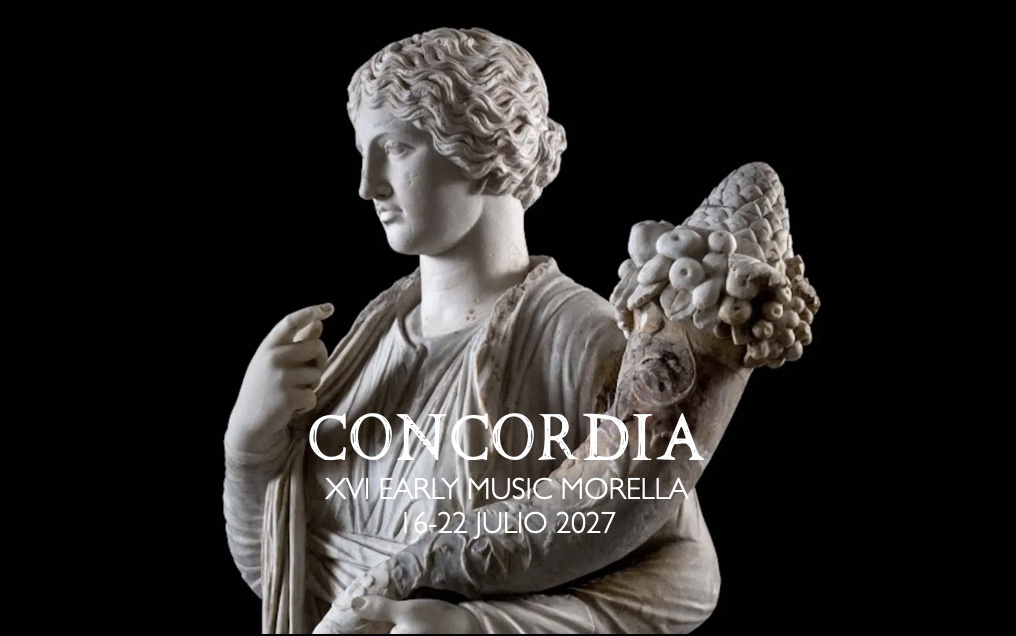
XVI Early Music Morella
CONCORDIA
July 16-22, 2027
Early Music Morella celebrates its forthcoming edition under the motto Concordia, a concept that evokes harmony, agreement and the coexistence of differences, and which becomes a particularly meaningful key to understanding the cultural history of the Mediterranean. In contrast to the tension and opposition symbolised by discord, concord represents a balance between diverse voices, consonance, the capacity for dialogue and the building of a community founded on coexistence, mutual respect and the pursuit of a shared good. In this sense, concord is not merely a moral idea, but also a way of understanding culture as a meeting place for different traditions, sensibilities and inheritances. We recall the “Concordia of Alcañiz”, the agreement reached on 15 February 1412 by representatives of the Generality of Aragon, gathered in Alcañiz, and of the Generality of Catalonia, gathered in Tortosa, to establish a procedure for choosing the successor to Martin I of Aragon, who had died without an heir. It also serves as a tribute to the Valencian humanist Juan Luis Vives and his 1529 writings “On Concord and Discord in Humankind”, a landmark work of Christian pacifism. In it, Vives unequivocally condemns war between peoples, advocating concord as an essential pillar of the “Philosophia Christi” in opposition to selfishness and violence.
Within the framework of Early Music Morella, concord takes on a central role as the organising principle of a festival that looks towards the Middle Ages and the Renaissance through the plurality of their musical and cultural languages. Morella, by virtue of its own history, is an ideal place in which to reflect upon the three cultures — Christian, Jewish and Muslim — and upon the mark they left on the formation of the artistic, spiritual and sonic imagination of the Iberian Peninsula. Concord, understood as coexistence and dialogue between diverse worlds, allows us to approach this legacy not as a collection of isolated compartments, but as a web of exchanges, influences and shared resonances that have shaped the cultural identity of our territory.
This 2027 edition is also linked to the celebration of the 40th anniversary of Capella de Ministrers, founded in 1987. It also coincides with the Year of Philip II, a decisive figure in the political and cultural history of the Hispanic Monarchy. His reign was a period of extraordinary complexity, shaped by the articulation of territories, languages, religious traditions and highly diverse cultural realities. In this context, the idea of concord acquires a profound historical meaning, referring both to the ideal of cohesion and to the tensions inherent in a plural empire. From this perspective, the festival can engage with the age of Philip II not only chronologically, but also through a reflection on unity in diversity, cultural diplomacy and the role of music as an instrument of representation, integration and prestige.
Within this framework, medieval and Renaissance repertoires will be explored that express concord in its different dimensions: as sonic harmony, spiritual balance and a metaphor for coexistence. Gregorian chant, sacred polyphony, repertories belonging to the Hispanic tradition, and music associated with courtly and urban contexts will allow us to explore how music historically served to order the sensory world and to propose models of concord between the soul, the community and the divine. Likewise, music connected with cultural exchanges between Christians, Jews and Muslims will provide a privileged framework for reflecting on the crossings of style, language and transmission that made a shared musical heritage possible.
During the Renaissance, music was understood as a means of education and civilisation, capable of refining the spirit and fostering harmony between individuals. Humanists and theorists emphasised its power to educate, move and order the passions, making it a privileged metaphor for social and moral concord. Vocal music, polyphony and courtly repertory expressed with particular clarity this aspiration towards unity in diversity, both in religious and secular spheres. Thus, concord manifests itself not merely as a theme, but as an aesthetic principle: in the organisation of voices, in the dialogue between styles and in music’s capacity to transform difference into shared beauty. As a musical guide, we may find a spiritual concord in Hildegard, Gregorian chant and Tomás Luis de Victoria; a communal concord in the cantigas, conductus and collective liturgical repertories; and a sonic concord in Josquin, Morales and Palestrina.
All this will take place without neglecting the musical adventure represented by instrumental practice, mensural notation, theory and compositional techniques in the Middle Ages and the Renaissance, as well as the origins of musical writing and its systems of notation, and the relationship between oral and written music. The combination of elements from historical music with those of oral tradition lies at the heart of Early Music Morella —music to understand, communicate, listen to, perform and enjoy through knowledge and reasoning.
In this edition, alongside the Festival concerts and the Instrumental and/or Vocal Advanced Course, audiences will be able to enjoy numerous parallel activities: guided tours, exhibitions, lectures, Med_Ren Jamsessions, workshops and a particular focus on international exchange initiatives, social activities and projects dedicated to the dissemination and promotion of early music among young people, older audiences and disadvantaged groups, as well as the introduction of a continuing professional development programme for teachers.
It will be a pleasure to share it all with you.


